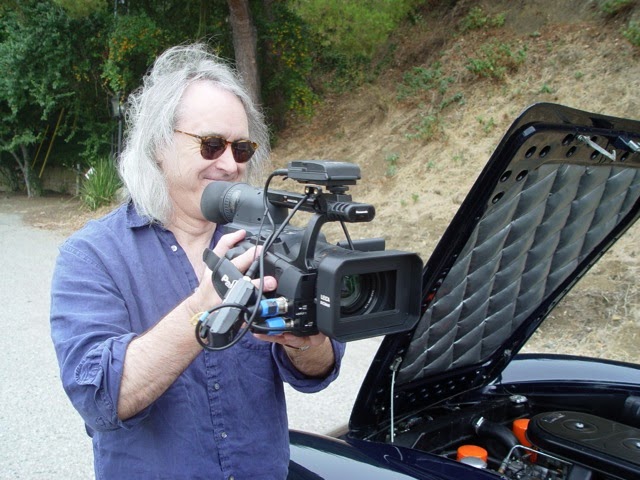
GTO 3987 on Mulholland

GTO 3987 on Mulholland

Thursday, December 31, 2009

Steve McQueen, James Garner, Jack Benny &...


The star of Elysée Wednesday this evening was John Ling who grew up in a showbiz family--his father wrote for the TV series Waterfront starring Preston Foster--and who worked for Sal di Natale back in the day in order to afford a 250 SWB Berlinetta with three over-sized Webers. He had some great anecdotes--Steve McQueen was always a gentleman who never complained about repair bills on his NART spider, James Garner wanted the aluminum Borranis on his 250LM chromed, Jack Benny drove a clapped-out Ferrari 250 Cabriolet that smoked from the tailpipes and from under the hood and how Sal drove the Alfa BAT from New York to California with his two babies tucked into the voluminous door side pockets. My favorite was the surprise birthday party John threw for Peter Helm at 5:30 one morning surprising blonde superstar Joey Heatherton in the process. John arrived in his Citroën SM, which collected a crowd of admirers, and we hope to see more of him.

Tuesday, December 22, 2009

Wilfred (WJD) Clarke: Of Bentleys, cricket and Lord's


I made my first trip to England at the age of 16 or so after making a few dollars working on a movie. I had no idea what to expect, but it was my intention to buy some old Bentleys to resell in Los Angeles. The advertisements in the back of Motor Sport magazine had caught my eye and London was calling. After flooding the bathtub at the London Hilton on Park Lane--a ritual common to many American visitors, I was told--I set out to meet with an older, Old School Englishman in Bromley, Kent from whom I bought not one but two vintage Bentleys. He was selling them to reimburse himself for a Radford Countryman S1 Bentley he had purchased of which he was rightfully proud.

He took me to his Bentley club in Surrey where the headquarters were an old coach house and stable from an age past. A most remarkable collection of Bentleys were to be found in the barn there. By day's end, this proper Englishman offered me the hospitality of his manor saying, "We can't have you staying in a hotel!" I stayed with him a month getting to know his son, daughter and even his former wife in that time. I was his guest many times in the ensuing years, as was my sister and her husband and even a former girlfriend of mine not to mention my good friend Gary Wales and his wife Marilyn. Wilfred was an extraordinary character right out of a P.G. Wodehouse story.

This nostalgia was brought on when, one night, my sister read aloud a letter from him she had saved. He referenced a photograph he'd taken with her in which he wore the same garish tie that was the only one he ever wore--his uniform, if you will. He referred to it as his MCC tie. I decided to satisfy an old curiosity by Googling MCC and discovered that it stood for the Marylebone Cricket Club. Not a cricket club--THE cricket club.

Now, recalling him taking me to Lord's Cricket Ground and arriving in that grand Bentley of his to watch matches suddenly takes on an entirely different significance--possibly one I wouldn't have appreciated at the time--one that, in any case, he was much too English to have pointed out to me.
What a marvelous and exceptional character he was--you could set your watch with the utmost accuracy by what he was doing at any given moment; reading The Times in the morning, a bit of lunch at Claridges, a glass of sherry towards evening. I miss him.

Tuesday, December 15, 2009

www.ledzeppelinnews.com/

Kevin's book gets its first review:


By Steve Sauer, www.LedZeppelinNews.com
Tuesday, December 15, 2009

On the ninth day of Zeppelin, my true love gave to me:
A how-to guide to Led Zeppelin's complete existence


Have you ever wondered just how Led Zeppelin ever happened? Whether life is directed by free will, or by the determined hand of an interested higher power, or by a never-ending random collision of molecules, the four-man and one-time-only collaboration known as Led Zeppelin did take place. The group did what it did, achieved what it achieved, and essentially played no more since 1980. Even with the realization that the circumstances that allowed Led Zeppelin to flourish at the time it did can never be repeated as, simply, times have changed, there is a lot to be learned from everything this band did over time, everything the band was about.

Kevin Courtright is perhaps the first person ever to approach Led Zeppelin's achievements as a finite list of lessons that can be passed on to hopeful musicians of the present and future. If there was ever another publication that attempts what "Back to Schoolin': What Led Zeppelin Taught Me About Music" accomplishes in about 400 pages, it hasn't landed on my shelf. This book isn't another unnecessary biography of the band. He leaves recasting the history to those who've already written it. What Courtright tells here, in a very logical and neatly structured organization of topics, is exactly what musicians can and should glean from knowing anything and everything about the band.

Led Zeppelin's story begins as two sets of virtuoso musicians who were strangers to one another met and promptly started checking things off the to-do list of the one who brought them together. Now already, I've hit upon several things that need to be analyzed further. Inherent within this statement are a lot of facts. The group consisted of four people; that's one. All four people were virtuoso musicians. Two knew each other, and two others knew each other, but neither half knew the other. One person, the founder, had preexisting notions of what could be achieved in this group setting. Only with the entire assemblage of all four could those things be tackled. And once that congregation was formed, their success in meeting or exceeding those goals was almost immediate.

The above paragraph is only my crude way of pinpointing some of the important lessons that can be observed without overlooking a single intertwined detail. Courtright's technique, which is much better undertaken than mine, is to dissect every aspect of the Led Zeppelin story in a unique and sensible format. The topics of his 32 distinct chapters spanning about 400 pages range from the band's collective and individual musical diversity, the art of improvisation, their use of dynamics, their use of tempos, and other areas not about the music but the presentation of it.

Lest we believe there is little to be learned from the procedure of titling an album, Courtright begs us to think again. He explains how the look of the albums resulted from a concerted focus on symbolism and mysterious imagery, preferred over group photos; how the creation of demand came about as a combination of perfectly timed tours and rare media interaction; the contributing ingredients to Led Zeppelin's success in the music business; and just why the band's influence is so lasting.

For each one of the 32 subject areas covered in this book, Courtright details Led Zeppelin's methods, what their achievements meant to him as an impressionable youth first turned on to their music, and how this can -- or in some instances cannot -- relate to any budding musical career in today's climate. I say "cannot" because, as Courtright allows: "[J]ust know that the tactics used by [Peter] Grant and Zeppelin are innovative and successful for them in that time, and any lack of compatibility with today is only indicative of how corrupt, controlled and crushing the industry has become. However, I maintain that with a 'grass-roots' movement of like-minded musicians, utilizing today's technology which does in fact afford some level of autonomy, the trend can potentially be turned back to an at least reasonably equitable state for today's artists."

This book is not a template for success in the music world. Billy Squier, Whitesnake, Kingdom Come and Bonham may have all had their time on the charts, but none was able to do what Led Zeppelin did or enjoy anything close to that kind of lasting power. It simply cannot be repeated intentionally. Still, if the idea that the band's existence can be summed up in a logical way across 400 pages appeals to the aspiring young musician you just know could be the next Jimmy Page, this is the right book for that person. This book will ensure that person seeks out the next Robert Plant, John Paul Jones and John Bonham.

Basically, if you learned something from reading last month's Web gem of eight lessons in creativity and productivity as gleaned from Led Zeppelin, you ain't seen nothing yet. Kevin Courtright is gonna send you back to schoolin'.

Sunday, December 13, 2009

Ariane Brodier

Last week at Elysée Wednesday, we were happy to welcome Ariane Brodier, a presenter on French television, who was visiting from Paris. Her inclusion came about as a result of a chance meeting on an airplane between actor Gérard Ismaël and Ariane's sister Sandie Brodier who lives in Santa Barbara and works in radio. Even those in the group who didn't speak French got on well with Ariane and Sandie who spoke English to bridge the gaps. Ariane is looking at the possibilities of working with filmmakers in the U.S. and it was a foregone conclusion that I invited her into the studio in January to do an episode of (Interview) version française. Sandie may not know it, but she will be receiving an invitation as well.

Thursday, December 10, 2009

Last night I drove a Ferrari 355 Spider F1


Last night, the Elysée Wednesday gathering culminated with my being handed the keys to a red Ferrari 355 Spider F1 by its very gracious owner, his only warning being that the hard tires were cold and he had once gotten the car perpendicular to the traffic pattern by applying just a little too much throttle under similar circumstances. I took heed.

Turning the key to the first detent, we wait for the fuel pump to fill the line, which takes but a moment. Then a twist and the engine bursts immediately to life at what seems to be a high-rpm idle. This is what I've always experienced with Ferraris as opposed to other, slower idling machines. The car wants to go.

Foot on the brake and a gentle pull on the right paddle and we're in first gear. We move off easily, the car giving exactly what I ask of it--no more or less. It exhibits a precision of execution that says racecar to me. We turn the corner and I wind it up to about 5000 rpm when a flick of the finger on the right paddle moves us into second gear. We're to 4500 rpm and another flick puts us into third. When I have to slow for the intersection where I need to turn, I brake and a flick of the left paddle takes us back to second gear. Another returns us to first. Nothing could be easier. There is a feeling of perfection to all of this. It feels right.

As I drive this Ferrari with the top down hearing the sound of the engine echoing off the trees, it does what all my Ferraris have done--it entertains and, in the process, reminds me of why Ferrari has been the only car rather than merely a good one. The suspension, the steering, the general feel of the car all reward the driver--me, in this case. Beyond the physical dynamics of performance, this car also engaged the senses and even the intellect, which is, in part, the definition of fine art.

I was tentative and respectful with the car as one should be the first time behind the wheel, but I was impressed by what the car offered me and aware that it had so much more to give once I came to learn its ways.

My thanks go to the generous owner of this 355, an Elysee Wednesday regular, who I will not name out of discretion.

Tuesday, December 1, 2009

"Up in the Air" starring George Clooney


Isn't it interesting that Jason Reitman's new movie "Up in the Air" starring George Clooney got a write-up in the Business section of the Los Angeles Times? Claudia Eller writes:

Six years ago, when Jason Reitman set out to write a dramatic comedy about a "corporate downsizer" who flies around the country and fires employees, the economy was booming and jobs were plentiful. By the time the young director, known for his 2007 hit "Juno," got around to making "Up in the Air," the world had drastically changed.

A display map of mounting unemployment across the nation looks like the fall-out map after the Chernobyl disaster. To see it, go here and click 'Play'.

"I can't imagine the pressure my parents felt when they ran out of money," Clooney said. "That's an experience our country is going through again in a big way."