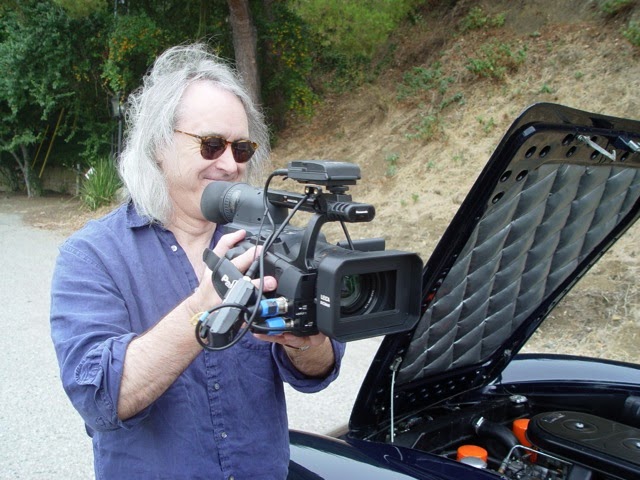
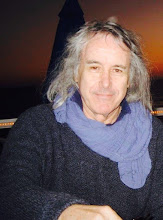
GTO 3987 on Mulholland

GTO 3987 on Mulholland

Thursday, March 25, 2010

My week on the Marne River


My week on the Marne River came a few months after I shot ‘Montmartre’ using Parisian actors who were friends or friends of friends. It had been a wonderful way for me to inaugurate a career as a writer-director. Paris had given us a cool but dry October in which to film. I shot in and around the art galleries, on the Place du Tertre and along alleyways that led nowhere yet were gateways to the imagination.

At the first screening of ‘Montmartre’, I made the acquaintance of a man who had enjoyed success in the insurance business and was looking to make a career change. My film had intrigued him. It didn’t take long to establish that we shared a passion for boating. He kept a sloop moored at Toulon; mine was a little further away at the Marina Del Rey in Los Angeles. Over dinner, we traded a sufficient number of sailing stories to establish our bona fides and the result was an invitation to spend time aboard his boat for a week. There we could discuss ways in which he might make a move into the entertainment industry. It wasn’t until a few days before our departure that I discovered our destination wasn’t Toulon, but Meaux.

While he did have a forty-two foot sailboat on the Mediterranean, he kept a forty foot cabin cruiser on the Marne River near Meaux, which would be our destination. So it was that we packed up and, with our girlfriends, drove off to an area famous for its mustard. The setting was an unspoiled harbor in a woodsy area next to a small inn. I tend to see settings in the context of movie locations, and this one couldn’t have been more picturesque. I don’t remember there being more than a dozen boats and we were the only people on the scene that day. After we brought aboard our provisions, my friend started the engine and we slipped out of the small harbor onto the Marne. We cruised along the river enjoying the late afternoon light looking for a place to anchor for the evening. We found it. There was a bend in the river that was wide enough to keep us well clear of any boat traffic and their wakes.

We set about preparing our first meal on board, which was probably filet mignon with fresh vegetables and frites, though it could have been macaroni out of a box and we would have savored it given the circumstances. The wine was a Bordeaux with outstanding credentials and we ate a meal that was memorable for its companionship. We were two couples who had only recently met, but were completely at ease with one another in the manner of old friends. After dinner, we smoked cigars (mine was a Davidoff Dom Perignon), listened to a tape of Miles Davis and hardly talked at all. I studied the stars in the sky and wondered to myself how life could get any better than it was that evening on the boat.

The next morning after our petit déjeuner, we swam in the river and sunbathed until we grew restless. My friend then steered the boat along the river until we came to a village where we docked and went off on foot to explore. We searched through the antique shops and bought from the boulangerie, charcuterie, and patisserie not to mention the local wine merchant before returning to the boat for lunch. I backed the boat away from the dock and motored down river towards a suitable spot to enjoy our meal. My friend and his girlfriend were eager to hear about my life in southern California. They were especially curious to know why I would leave behind two Maseratis, a sailboat and all that was Hollywood to come to Paris to start a filmmaking career. I explained that I had been seduced by French cinema and the style of life it depicted. I told them I felt more at home in Paris than I did in Los Angeles where I was born.

They wanted to hear the details of the time I spent on the sets of American television series like ‘Mission: Impossible’ or the movies I’d worked on like ‘Winning’. They hungered for Hollywood in the same way I needed Paris. We agreed that spending half our time in France and the other half in California might be the ideal. Having arrived at this consensus, we washed the dishes and went swimming again before worshiping the sun once more. It wasn’t until late afternoon that we got around to the subject of business. What could we do here that could be sold in America, my friend wanted to know. Was there something that could satisfy my desire to shoot in France and his to be involved with Hollywood? The answer didn’t come that day.

In fact, it would be weeks before I came up with the idea of shooting a television pilot using a French actor speaking English that would be equal parts travelogue, cooking and comedy. It wasn’t until July that we engaged Philippe Léotard, who didn’t speak English at all but mastered the dialogue phonetically. Rolex provided a yellow gold Day-Date, Renault an automobile and Alain Bernardin one of his dancers from the Crazy Horse Saloon. La Mère Catherine on the Place du Tertre provided the location. It would not be the last time I was to shoot there. ‘The French Chef’, as the pilot was titled, became a calling card that opened doors to the major production companies of Hollywood for my friend and me. His dream of becoming a Hollywood producer would be realized.

None of this was known to us that afternoon as we enjoyed the quiet atmosphere of the river and easy rapport of our new friendship. The next day we were joined by another couple. My friend became circumspect in their presence not wanting to speak of his aspirations regarding Hollywood. It didn’t matter. The river had already worked its magic.
http://www.youtube.com/watch?v=WHUsoYUqEl8

Monday, March 22, 2010

John Surtees


During my teens, I followed the Can Am series and have some great recollections of the sights and sounds of those exciting cars at Riverside and Stardust raceways where I was able to attend. Standing along the back straight at Riverside watching Dennis Hulme and Bruce McLaren race past on the opening lap mere inches separating their cars at 190-plus miles per hour is an experience not to be forgotten. They had already established a commanding lead over the rest of the field and they hadn't yet reached Turn 9!

It was in the pits at Riverside Raceway that I got to rub shoulders with Stirling Moss (never saw him with a shirt on), Bill Hickman (he drove the Dodge Charger in Bullitt) and Brock Yates (who wrote great pieces for Car & Driver magazine). It was at the Stardust Raceway near Las Vegas that I met Henry N. Manney III who wrote inspired and inspring articles with his uncommon wit for Road & Track. I actually met him on the track itself prior to a parade lap featuring a lot of Ferraris from the Ferrari Owners Club.

That year, my father rode up with me to Las Vegas to see the Stardust Grand Prix. His function was to watch for the Highway Patrol and police vehicles from various jurisdictions along the way. With his assistance, we made it from Woodland Hills to Las Vegas in world-record time and I am not exaggerating! We were in my Ferrari Berlinetta Lusso and took full advantage of the car and the fact that Nevada had no speed limits. In California, my dad was watchful, let us say.

We participated in the parade lap of Ferraris, which was rather interesting because the driver's side of my car was bashed in--not a cosmetically perfect specimen like the rest of the Ferrari parade cars. You see, the week before, my father had borrowed the car for an evening and, while stopped at a red light two blocks from home, a drunk driver slammed into him. He wasn't hurt but the car looked a disaster. So it was in this condition that we took part in the parade lap and it was the pitiful condition of the Lusso that drew Henry Manney's attention and provided me the occasion to meet him. Go figure.

I had long been a fan of John Surtees who was Ferrari's number one driver. I almost bought a 330 GT 2+2 from him after David E. Davis wrote in Car & Driver that John was selling it. I remember getting a telegram from Surtees described the car and its 'grey external cellulose'. In the end, I bought the Lusso instead but I held onto that telegram for the longest time!

The year my father and I attended together, John Surtees won the Stardust Grand Prix in his Lola T70 Mk3B. Afterwards, I sat next to John in the steward's shack while he was being interviewed about his victory. A journalist asked him how much fuel was carried onboard the Lola and I'll never forget his answer. Surtees said, "We calculated the race distance and duration, the rate at which the car burns fuel and the effect of desert temperatures on evaporation. Then we filled the tank to the brim."

Tuesday, March 9, 2010

Bud Ekins


I once drove my GTO to Phoenix, Arizona in order to break in the engine after a rebuild. I chose the destination because my mentor, the television director Paul Stanley, was directing an episode of Then Came Bronson on location there. The series was sort of like Route 66 on a motorcycle starring Michael Parks. I left Los Angeles late one evening and arrived in Phoenix the next morning. I don't think I went over 5500 rpm the entire trip.

It was fun getting to know the car driving through the desert in the middle of the night listening to the V12 engine singing its song. The next day, I met up with the production and it seemed I gave rides to the entire crew during their lunch break. I met Michael Parks who pretty much kept to himself. I also met Michael Burns who had been a child actor whose career carried on into his adult years and who introduced me to Ramos Gin Fizzes for which I am eternally grateful. I also ended up spending most of an afternoon with some guy sitting in a station wagon in order to stay out of the desert sun. The guy liked motorcyles. Whenever Michael Park's character needed to be seen on his motorcyle, it was this guy who rode the bike. The guy's name was Bud Ekins.

I knew Bud's name because he had a motorcyle shop in Sherman Oaks. The name was also familiar to me because he had stunt-doubled Steve McQueen in Bullitt. Bud drove the McQueen Mustang in many of the scenes--whenever the rear-view mirror is turned down, it's Bud at the wheel. He also put down the motorcycle on the freeway during the chase scene, his only protection being his leathers and a helmet. Bud was equally famous for having made the motorcycle jump in The Great Escape. I say famous, but perhaps only to those close to the business, for the public was allowed to believe that McQueen performed the jump. We talked a lot about McQueen--Bud had only good things to say about him--and about the making of Bullitt. He spoke of Carey Lofton who also worked on Bullitt, but I don't recall any mention of Bill Hickman who drove the Dodge Charger in the film. Bud was an easy conversationalist and as unpretentious as anyone could be. I could see how he and McQueen would get along together.

This encounter reminds me of how, yet again, I was able to meet an extraordinary individual thanks to the extraordinary car that I owned for a few years. Had I not needed to break in the GTO's engine, I doubt I would have made the trip to Phoenix and I never would have spent that afternoon shooting the breeze with Bud Ekins.

Friday, March 5, 2010

Hélène Cardona--The Astonished Universe

Last week, I shot this visual exercise with Hélène Cardona, author of the Astonished Universe, in which she recites from her book of poetry.

Tuesday, March 2, 2010

Frank Sinatra


During the time I was taking filmmaking courses from the sound and cinematography department heads at CBS Cinema Center (Elliot Bliss and Peter Gibbons respectively), hanging out on the sets of Mission: Impossible, Medical Center, The Road West and others, I had the idea that it would be good to get some experience on the other side of the camera. Doing some acting might give me a perspective on directing that I would not otherwise get. I mentioned this to my stepmother. She told her friend, who told her husband--a vice president at the Sands Hotel in Las Vegas--who passed this information along to--Frank Sinatra (!!).

Without knowing that any of this was happening, I get a phone call one afternoon from someone who introduces himself as George Raft. His voice was very distinctive and recognizable as that of the actor famous for his gangster roles in the movies. There was no question of this being a prank call. To my surprise, he suggested I make an appointment with a friend of his who was somebody important at the Screen Actors Guild located on Sunset Boulevard. The man would be expecting my call. I thanked Mr. Raft and, without knowing what was afoot, I made the call. The gentleman set an appointment with me to come to his office, but I still did not know the purpose of the visit.

On the day, I arrived at the S.A.G. offices and was greeted by George Raft's friend who took me on a tour of the building. It was an office like any other and I was perplexed at why I was being shown a room full of typists and administrators but I kept a respectful silence. He then led me to his office where, it seemed, we would get down to the business of my visit.

The problem with obtaining a Screen Actors Guild card is that it is a chicken-and-egg situation. First you get a job and then they give you the card--except they won't give you the job without the card. See what I mean? Although I was aware of this, I was expecting to have this fully explained to me by George Raft's friend and to be sent on my way with kind regards and sincere apologies. This is not what happened. Something else entirely transpired.

He asked my name, address, date of birth--everything an employer might ask of an applicant with one interesting addition: What name do you want to use because your name is already taken and S.A.G. doesn't allow duplicates. At the end of our meeting, I left the building with a S.A.G. card.

When I returned home, I called George Raft to offer him my thanks for his extraordinary gesture. "Just do good, kid" was what he said with that gangster voice of his.

Many years later, after the passing of Frank Sinatra, I read an article about him that shed a light on what he had done for me. It seems that Sinatra made a habit of doing things for people--things they could not do for themselves. He did this anonymously and without fanfare. It was his custom to delegate these 'favors' to his immediate circle of friends. In my case, I suppose George Raft was next in the rotation. Many of the favors that were written about were of far greater consequence than getting a teenager his guild card and, no doubt, had dramatic effects on the recipients' lives.

It was only after Sinatra was gone that those who knew him were able to speak of his generosity. It helped me to understand what had happened though I don't imagine that I'll ever know why it happened. I am a great fan of Frank Sinatra--for his music as well as for his acts of kindness.