GTO 3987 on Mulholland

GTO 3987 on Mulholland

Tuesday, September 27, 2011

Ferrari GTO photos from Larry Crane

In recent months, I've made the acquaintance of Larry Crane after Richard Mitchell said I should speak to him about his Carrera Panamericana tribute Ford as I was shooting the Carrera documentary at the time. I made contact with Larry and he graciously joined us in the hills of Griffith Park so we could include footage of his car and an interview with him in the Carrera documentary. During lunch at the Figaro Bistrot on Vermont, I discovered we both loved cars to an extraordinary degree and shared an appreciation for David E. Davis, Jr.

In the months following our first meeting, Larry has attended Elysée Wednesday--usually with Ed Niles in tow--and we have exchanged our views on various car-centric subjects. A few days ago, Larry wrote to me saying he was interested in doing a profile piece on me for Westlake Malibu Lifestyle magazine. Why not? It was during the course of his interviewing me that he makes reference to photos he shot of my Ferrari GTO. This took me by surprise and I asked if I could see them. He sent them immediately.

What surprised me was that--though the photos were obviously taken during the time I owned the car (SM1 license plates being the most obvious telltale)--I did not recognize the time and place shown in the photos. Larry remembered. He told me he had snapped the photos in the paddock at Riverside Raceway. That unlocked the memory. I'd driven alone to see a Can Am race and spent most of my time wandering about the garages rubbing elbows with (Sir) Stirling Moss, Brock Yates, Bill Hickman and, of course, the drivers who were racing that day. I remember standing near the end of the back straight watching Dennis Hulme in his amazing McLaren M8D flying towards the braking point for Turn 9.

I wouldn't have imagined that, while I was walking about like a kid in a candy store taking in as many of the sights and sounds of an important race as I could, someone I'd meet a lifetime later would happen upon my car and take the time to photograph it thereby providing me a memory that would have been lost forever had he not done so. I didn't have a camera that day but I am very glad that Larry did. I told him that I really enjoy the fact that the photos show my GTO parked casually between a Ferrari 275 GTB and a 289 Shelby Cobra. Weren't those the days!

Sunday, September 25, 2011

Reno Air Show crash: Gary Barnhill comments


My friend Gary Barnhill flew the F-100C as one of the USAFE Skyblazers based on Ramstein Air Base in Germany. With his permission, I am publishing his comments on the recent Reno Air Show crash.

Regarding the high G load and the pilots age:

In 1965, very early in the air war over North Vietnam, we were searching for new and more effective tactics. This did not require a lot of motivation to search in earnest.

Flying the F-105 Thud I rolled in quite high on a target with the intent (unauthorized) of experimenting with a pure vertical strafe run. Normal strafe runs were ten to 30 degrees in training. The sleek and heavy Thud hit 1.2 Mach real fast and I gave a good pull on the stick as you can imagine the the ground was coming up rather fast.

The next thing I remember was slowly regaining consciousness and both hands were clawing at the side of the canopy (as in: let me out of here). For a brief period I had lost contact with being a pilot flying an aircraft.

The Thud was going nearly straight up. Consciousness returned in time to recover to normal flight.

George Zigelhoffer advised all three gear were hanging out. Return to base was uneventful.

It was determined that something in the controls malfunctioned and the aircraft pulled 13 g. George observed the aircraft sorta swapped ends and went from vertical down to vertical up.

My point is; at age 29, wearing an inflatable G-suit and being in good health (if you don't count the smoking and drinking) I totally blacked out and was not longer flying the aircraft.

IMHO, the P-51 pilot became unconscious as a result of "snapping" on 11 or more g. One report claims 22 g. I believe the result would have been the same for a younger pilot wearing a g suit.

We sat upright in the Century Series jet fighters (F-100, F-101, F102, F-104, F-105, F-106).
I don't know if the P-51 racer's seat was inclined like a Formula One race car or the modern jet fighters.

I think it possible the small bit of aircraft change of direction shortly before impact was the result of the pilot stirring somewhat in the process of regaining consciousness. The poor guy was just a few short seconds short of recovering.

Gary Barnhill

Thursday, September 22, 2011

The Plush Bunny


I found myself standing at the entrance of the Plush Bunny behind a velvet rope when someone waiting to get in asked me a question. There was too much noise--a band playing inside the club and a noisy crowd outside--and I didn't hear what he was saying. I was about to ask him to repeat his question when I saw that he was preparing to punch me in the face. Talk about telegraphing a punch, this guy took a longer wind-up than Hideo Nomo. I was going to wait for him to throw it and parry the blow. As a guest in Matthew's night club, I didn't want to abuse his hospitality by delivering a counter-attack to one of his paying customers. Before any of this could develop and before the fellow could conclude his extended wind-up, a fist went flying past my left ear from behind and landed squarely on the malcontent's nose causing a deformation worse than the time Matthew crushed the front end of the Breadvan into a mountainside in Malibu. It was 'lights out' and the fellow dropped like the proverbial sack of potatoes. Ronnie Melthrotter had a devastating right and was never slow to demonstrate it. He ducked under the rope and gave the fellow a nine-count while his assistant Richie glowered at the crowd discouraging any further shenanigans. As the fellow regained consciousness, his friends carried him off to a car never to be seen again.

The 'Bunny was an interesting night club and Margaret Mead would have found plenty to fascinate over watching the dynamics and inter-actions of the patrons and staff. There was always live music, minimal conversation and some pool tables. I was commonly at the 'Bunny when I should have been in school--I signed up for night classes because Peter Gibbons and Elliot Bliss were teaching cinema classes in the evening after putting in a full day at CBS Cinema Center as heads of the camera and sound departments. I got straight As in all my courses, so my absences did no damage. The same might not be said of my attendance at the 'Bunny. I became quite a good pool player though I discovered you can shoot ten great games and the eleventh reveals you to be a complete fraud. The music was hot, the girls were hotter and there was always action of one sort or another to keep things from getting dull.

Regularly, Matthew would appear at the door to his offices and motion me inside. I'd follow him through the outer office--always filled with people I didn't know and whose function was undefined except to say you sure as Hell weren't going into the inner office to see Matthew unless you were invited or were one of the inner circle. I had open access. I would be summonsed to hear a wacky deal proposition from someone completely out of touch with reality, to meet an amazing woman or to be introduced to some legend in the Ferrari world. Nothing short of these would warrant pulling me away from the pool tables and the other action in the club. This was 'A Moveable Feast' that delivered to your door.

Every year, the 'Bunny celebrated New Year's Eve by announcing a gala presentation of the Ike & Tina Turner Revue. It was always a sell-out and much anticipated. I would be surprised if scalpers weren't re-selling the tickets. I always made it a point to be present. Every year, at the beginning of the evening, Matthew would go onstage to make the introduction for the night's entertainment, but only after reading aloud a telegram from Ike Turner apologizing for their absence and explaining that the tour bus had broken down in Blythe or some other godforsaken place. The replacement would be Mr. Clean, a black saxophonist with a shaved head who did great Junior Walker covers, or El Chicano playing their then current hit Viva Tirado. In any case, no one wanted a refund.

At two in the morning when the club would close, Matthew and I would climb into our Ferraris-- the Breadvan and the GTO--which were parked at the club's entrance and race away with the girls we had invited to breakfast. I usually made it home by ten the next morning and to school for afternoon classes. In the following years, Matthew would have other clubs but they were more conventional and not the exclusive sort of domain that was the Plush Bunny. What wonderful times they were!

Monday, September 19, 2011

Ferrari on Mulholland (again) raw footage


I thought I would post some clips of our morning on Mulholland. No editing or narration--just raw footage. A teaser of things to come.

Saturday, September 17, 2011

Ferrari on Mulholland (again)


Mulholland Drive is an iconic road to anyone growing up in Los Angeles combining the properties of a Lover's Lane and a Mille Miglia-style road course. It overlooks the San Fernando Valley on one side and Bel-Air, Beverly Hills and Hollywood on the other. It represents a sort of carefree abandon that cuts across and through the serious nature of a sprawling city. It is escapism from an enforced reality and the reality of those who have escaped, if only for the duration of an exciting drive.

In my youth, I enjoyed such a reality when Peter Helm, his friend Rick and I took our Ferraris onto Mulholland for some fun which Peter captured with his 8mm camera. Yesterday, at the instigation of Elysée Wednesday regular Richard Mitchell of Black Horse Motors, we took a literal and figurative trip down memory lane and drove a Ferrari 330 GT 2+2 along the same stretch of Mulholland between Beverly Glen and Laurel Canyon.


We were accompanied by Jeanette Dumouchel, a producer with me on the Carrera Panamericana documentary, and Chad Glass who rendered the poster for the doc. We all took a turn at the wheel of the Ferrari and while the vintage handling of this thoroughbred was a new experience for a couple in our group, it was a strong dose of déjà vu for me. The familiar sound of the free-revving 4-litre V12, the feel of the big Nardi steering wheel and the action of the 5-speed transmission (it was a late series model) conjured an era that is long gone but no less exciting for its passing.


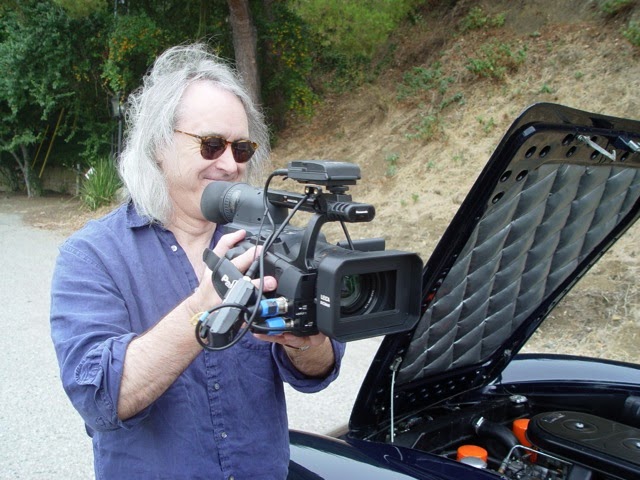
We documented the entire drive with the Panasonic P2 HD camera and, at one point, we stopped along the side of the road to shoot static shots and stills of the car. The 330 2+2 is much more compelling in life than in any photos I've ever seen. This one, originally sold by a wily Enzo Ferrari to Pat Boone who had really wanted to buy a Superamerica--no one ever made a success of saying no to Il Drake--is in beautiful condition and attracted the attention of one the ubiquitous tourist vans that cruise the city which stopped in the middle of the road to gawk at us.


Though I felt at home in the 330, I told Richard I would need at least an hour with the car to be comfortable finding its limits. As a 2+2, it is not the Lusso and far removed from the GTO in which I enjoyed this road in the past but it was great fun to drive and was really intended as a comfortable, high-speed touring car for the Friday night rush from Paris to Toulon for a weekend of sailing.

My thanks to Carl Steuer of Black Horse Motors and, of course, Richard Mitchell for a most enjoyable morning!

Thursday, September 15, 2011

Jim Russell Racing Drivers School


When I first became interested in sports and racing cars, I read everything I could get my hands on that dealt with the subject of high performance. Road & Track, Motor Sport and Car and Driver magazines were must-reads. Add to those the elegant and beautifully produced Automobile Quarterly and one could learn quite a lot about cars and the people who made and enjoyed them. Of course, I wanted more than to just read about these experiences. I wanted to take part. I wanted to race cars.


I began by reading two excellent books. The Technique of Motor Racing by Piero Taruffi and Racing and Sports Car Chassis Design by Michael Costin and David Phipps. It would be more accurate to say that I devoured these books reading them over and over. I began to understand apexes and braking points and concepts like polar moment of inertia and center of gravity as they applied to making a car move faster through a corner. It was a good start but I wanted more.


So it was that I went to the Jim Russell Racing Drivers School with its classroom near Rosamond, California using Willow Springs Raceway for the practical application of the lessons taught. It was my first time in an open-wheeled formula car--a Lotus Formula Ford. There was no synchromesh on the gears so one had to match engine revs with every shift while learning how to control every aspect of the car's behavior to the maximum extent possible. It was a lot to concentrate on because it was not driving for fun, it was driving for precision. Surprisingly, I was told to limit my revs--and therefore speed--and to focus instead upon accuracy with regard to braking points and apexes, entrance and exit points when cornering. As I would later experience when learning to fly glider planes, the deep concentration of the early stages became seat-of-the-pants instinct very quickly.

As we progressed, authorized speeds were increased. Finally, I thought I was moving along at a pretty fast pace between Turns 2 and 3 when a track version of a Shelby Mustang GT350 blew past me like the Lotus was parked, which taught me a valuable racing lesson that applies to street driving as well. Always keep an eye on your rear-view mirrors.

Months later, my familiarity with the track served me well when my friends and I spent the day at Willow Springs with the GTOs and several other Ferraris. More recently, John Fitch told me something I hadn't considered offering an interesting perspective. He said, "It is more important to go fast in the faster corners than in the slower ones since you gain more time in the longer corners." Rest assured, I've been putting that into action.

I have always thought that schools like Jim Russell should be required of all who drive a car on public roads. I think the current driving tests--at least in California--serve only to notify the public of the codes for which they will be fined when they are violated and have nothing to do with car control and competence.

This from Ed Niles:

"Sweet! In the early days of our marriage, around 1975, I put Phoebe through the Bondurant School, and she had a ball and came out a pretty fast driver; faster than I, for sure. The timing and the money never coincided for me, so I have lacked that experience. When we had the 275GTB/C she beat me up the Virginia City hillclimb. The timers were afraid to tell me, thinking my ego couldn’t stand it; I was actually quite pleased that I got my money’s worth! Ed"

Monday, September 12, 2011

Val Guest: The Day the Earth Caught Fire


One of the pure pleasures of the modern age is being able to communicate with those who might have been out of reach in earlier times. One such occasion was when I tracked down the British film director Val Guest who made one of my favorite science fiction movies of all time--The Day the Earth Caught Fire. I saw the film as a kid--probably at the Aero Theater in Santa Monica on Montana--and was enthralled by the concept of a London plagued by hurricanes followed by scorching heat and the unforgettable heat mist that rose only four stories high and was as thick as the worst London fog. Edward Judd played the lead role with Leo McKern and Janet Munro making great additions to the cast.

At one point in my adult life, I had a desire to see the film again so I visited The Continental Shop on Wilshire in Santa Monica which specializes in British imports--everything from licorice toffee to fine china tea sets. They also offer an extensive collection of British films and, happily, The Day the Earth Caught Fire was among them. The gentleman behind the counter who transacted the sale fell into conversation with me about the film. It was one of his favorites, too. We talked about Val Guest and some of the other films he'd directed including the original Casino Royale on which Val was one of several directors. I made the comment that I would love to meet him. "He lives in Palm Springs, you know," said the gentleman. "He's a customer of ours."

The next day, I found myself speaking on the phone with a very amiable Val Guest who was more than happy to receive my call and discuss The Day the Earth Caught Fire. He had taken special pains with the script to ensure that it was a grown-up, intelligent look at the subject (nuclear testing) and that it wouldn't fall too far into the category of make-believe. I think he did an excellent job and told him so. Val told me he felt that Arthur Christiansen (editor of London's Daily Express who essentially played himself and stood as technical adviser for the newspaper sequences) might have been weak in the acting department. I told Val that I thought Christiansen's performance was the most memorable of all and--like the Dude's rug which really tied the room together--anchored the film in reality making everything else that much more credible. Michael Caine can also be seen in a small role as a policeman directing traffic during the havoc.

It was our habit to hold a quarterly exposition of all the work--film and television--produced by the repertory company in the previous months. It was a way of allowing everyone in the organization to see what others in the company were doing and was an enjoyable form of celebration. In the months where the desert heat relented, we held this convention in Palm Springs at the Ocotillo Lodge. We would gather near the pool in the evening and screen scenes from the many projects outdoors. It was my wish to invite Val to one of these where he might speak to the actors and filmmakers in the company. He seemed delighted by the suggestion and said he would be happy to attend.

The next two "film nights" took place in Los Angeles owing to weather and before a Palm Springs event could be scheduled, the repertory company came to an end. I regret not having made a special trip just to meet Val Guest. We spent a considerable amount of time on the phone and I know that we would have closed whatever restaurant Val would have chosen for our conversation about film. Alas, it was never to be and is a missed opportunity I regret.

Last night, I watched The Day the Earth Caught Fire for the umpteenth time and found it as engrossing as the first time I saw it. I am glad that, at least, I had the chance to tell Val how much I liked his movie.

Thursday, September 8, 2011

Jaguar E-Type


My first car was an E-Type Jaguar. It was a yellow coupe; the last of the 3.8 litre cars with the covered headlights and the lowered foot wells. It had a black leather interior with the completely black dash whereas earlier models had a bare aluminum centerpiece. I thought it was the most beautiful car in the world. Quite a few others thought so, too, and would tell me so whenever I was broken down at the side of the road waiting for a tow truck. I should have listened to family friend Paul Stanley who tried to convince me to buy a Corvette instead. Paul drove an impeccable, 1959 fuel-injected Corvette that he later left in my hands to drive and take care of when he went to Brazil for a month to shoot episodes for a Tarzan television series starring Ron Ely. I didn't listen to him. I wanted the Jaguar.

I looked at quite a few E-types and somehow, with my father's help, talked the sellers into letting me take their cars to the Hornburg Jaguar dealership on Wilshire Boulevard in Santa Monica for a mechanical inspection. My father helped me ferry the cars from as far away as Pasadena and we ended up with three of them--all yellow E-type coupes--getting inspected on the same day. It was quite a sight!

I made an offer on the car with the best inspection report and, at 16, became the proud owner of a slightly used E-Type Jaguar. On the same day I collected the car, I left on a trip to Oklahoma thinking it would be a great way to get to know it. I had it fully serviced at a Jaguar dealership near the seller and drove off feeling very enthusiastic about my new car. Within a mile, the water temperature gauge soared off the scale and from the louvers on either side of the power bulge came billowing clouds of steam. As D.S. Jenkinson used to write in Motor Sport magazine, there's nothing like "Jaguar motoring"!

I made it back to the dealership where it was discovered that the mechanic had forgotten to put coolant in the radiator after he had drained it. An honest mistake and there was no chance I'd be returning to this dealership for future service given its location. So, it was off we go, Take 2. The first destination was Las Vegas where an honest working man could still get a square deal at the dinner table if nowhere else. About the time I got to Victorville, I had the sensation that one of my tennis shoes was melting and that I was getting a third degree burn on the bottom of my right foot. I pulled to the side of the road to find that my tennis shoe was melting. The accelerator pedal on the Jaguar was metal and not covered with a rubber pad and what with the extended driving in the desert heat...

After rummaging in the 'boot'--an early version of a hatchback door that opened sideways--I threw on a pair of dress shoes that I wore only at weddings and Sunday brunch at Scandia and continued on my way wondering if Jenks ever drove his beloved Jaguar in the desert.

Chickasha, Oklahoma had never seen an E-Type or any other sort of Jaguar before. I know this because it said so in the newspaper which ran an item about the car within days of my arrival. I remember being parked at the local A&W enjoying a root beer float when a car full of girls screeched to a stop and in unison they cried out, "California plates!" as though they'd just seen Elvis. Hmmm...

I don't remember much else about the trip other than I loved driving the car and would go for long drives to nowhere in particular. The trip home was uneventful unlike the rest of my experience with the E-Type. One thing after another broke, fell off or ceased to function until the final straw brought about our divorce. I was going to Riverside Raceway to see the Times Grand Prix and had been looking forward to the driving the Jaguar. That morning, I hand washed the car which was my habit. I slipped into the driver's seat and belted up. I inserted the ignition key and turned it to the on position. I then pushed the starter button and CLANK! This was followed by what sounded like a jackhammer being dropped on concrete. I suddenly regretted ever having read Motor Sport magazine or any of Jenk's columns.

It took only a few minutes to ascertain that the CLANK had been the starter motor and the second sound was produced as it hit the garage floor after separating from the engine--launched like a grenade, as it were. My "Jaguar motoring" had come to an end and I drove the family Cadillac to Riverside that day. Soon after, I sold the E-Type and bought a sensible car that had no reliability issues for the years I owned it--a Ferrari Berlinetta Lusso.

Monday, September 5, 2011

Shelley Hack


When I was in Michigan visiting in-laws, I would call Kathi Carey, who was my "right hand" and talented actress, writer and director in my organization, to get updates about the goings-on. During one of these phone calls, Kathi tells me that Shelley Hack had called after seeing one of the (Interview) shows on TV and wanted to take me to lunch. My first question was, "Who is Shelley Hack?" This may seem strange coming from someone totally immersed in making films and television shows but her name hadn't registered with me though she starred in the series Jake and Mike and had made a big splash in the Charlie's Angels series not to mention her great walk-on in Woody Allen's Annie Hall. I asked Kathi to set up a lunch at Musso & Frank--a favorite restaurant of mine--on a day following my return to Los Angeles.

I forget now which segment Shelley had seen but as we enjoyed our lunch together, she wanted to talk about the show and the possibility of using the underlying story as the basis for a movie that would cast her in the lead. Like many who had seen the show on cable TV, she was buzzed by the story and the unusual manner in which it was presented in the context of a fictional interview. When it became obvious that we were both interested in the idea of developing the story into a vehicle for her, she arranged for us to meet after lunch with her manager to move the idea forward.

Our lunch conversation turned to the workings of the film business in general and I trotted out a few bits of advice I would give to actors as they would join the repertory company. The most important of these was that an actor's viability relied upon the number of film directors who are aware of the actor's signature, on-screen skills (not thinking to use the word brand in those days) and had witnessed his or her performances. I thought of this as basic Marketing 101 given that it is a director who decides who gets cast into a film--the casting director makes recommendations after filtering out most of the candidates. In the end, it is the director's prerogative. For lead roles where 'bankability' enters into it, add the category of producer. It was the first time Shelley had given consideration to this and wanted to hear more and I was happy to tell her. Before leaving Musso's, Shelley wanted to know what my terms were for the sale of my (Interview) stories. When I told her, quoting a ballpark price and credits, she laughed good-naturedly saying I reminded her of someone.

After lunch, we drove separately to the office of Shelley's manager's on Sunset Boulevard near Doheny. Shelley was there when I arrived and he understood why I had been invited. We spoke of the story and how it could be presented discussing the project's potential as a film or TV movie. It was a good meeting and it was obvious to him--and to me--that Shelley was excited about moving the project along. As the conversation wound down, however, the manager said something to the effect that, in the final analysis, they could proceed on the project without me by changing a few of the story elements. I suddenly saw him in a new light and wanted nothing more to do with him. It might have been my imagination, but I sensed that Shelley was embarrassed by the remark.

I left his office thinking that it isn't often that one meets the best and the worst the industry has to offer in the same day.