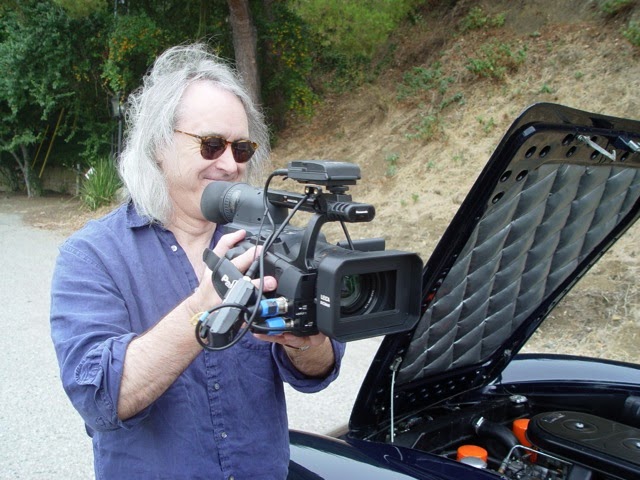
GTO 3987 on Mulholland

GTO 3987 on Mulholland

Sunday, June 13, 2021

From Tom Maseth


 "I have some great news I want to share with the people on your Branding For Actors FB Page and you Stephen. I will have a character / supporting role in an upcoming SAG-AFTRA film to shoot some time later this year. The reason I have landed the role without an audition is the lead actor/producer has seen my work in both Exigence and The Dearly Departed (2017). He is a big proponent of the Action / Reaction method of acting. Thank you Stephen! The impact you have had on my acting career thus far has been significant. So looking forward to how much more of an impact you will have on my acting career as my journey continues."

Thank you, Tom!

Wednesday, June 9, 2021

Exigence & The Dearly Departed update


On May 19, Exigence and The Dearly Departed have been delivered to Vimeo (TVOD service available throughout the world).

Exigence on Vimeo on-demand

The Dearly Departed on Vimeo on-demand 

On June 9, The Dearly Departed has been selected by rlaxx TV, which is available on Xbox, Xumo, FireTV, Roku TV, iOS, Android.

Monday, May 31, 2021

What does a producer do?


What does a movie producer do, anyway? According to Richard Corliss, one of the editors of Time magazine: This is the Hollywood equivalent of Freud’s “What does a woman want?”

The most popular misconception I run into is that a producer is someone who funds your movie. If that were true, we wouldn’t need the term “investor”. It may be that a producer attracts money to a project but that is only a part of his or her job of attracting anything and everything a project needs to be viable and get up onto its own legs.

After I left Paris and returned to Los Angeles to market The French Chef which I’d shot with Philippe Léotard, I found that I was getting interest in The Crazy Horse Saloon revue which was situated on the avenue George V. I had met with Alain Bernardin, the owner of this Parisian landmark and had secured the rights to the show for cable TV in the US. Not realizing it at the time, other US companies had already been negotiating with Alain for those rights including Al Burton who was Director of Development for Norman Lear. The rights went to me—for a token $1. You might say, a producer’s job is being in the right place at the right time and being able to speak French.  

I developed a good rapport with Alain and he offered to “lend” me one of the Crazy Horse girls to act as Philippe’s assistant when I shot The French Chef. Alain approved of the fee I offered her and we had a deal. I think a good producer realizes you don’t build a hamburger stand to cook one hamburger and so it was that I involved Bernardin, if indirectly, in another of my projects. You will often hear a good producer speaking of “relationships” he or she enjoys and without those ties to interesting and important people built upon past associations, a producer is hard-pressed to produce.

Interestingly, though I had selected her from a line-up of girls arranged for me by Alain one afternoon at the Crazy Horse, I was not prepared for the girl I picked up at her apartment in Paris the morning of the shoot.

I am sorry to say that I don’t remember her name but she was an American blond living in Paris and working in the Crazy Horse revue. Though I had expected all the girls to be French—a romantic notion, perhaps—most of the girls in the show were from other countries. I picked her up early in the morning and she climbed into my car wearing jeans, a flannel Pendleton shirt and no make-up. 

She was carrying a wardrobe hanger and, for a moment or two, I thought she was a friend of the girl I had selected and was coming along as a wardrobe mistress or make-up artist. When she settled into the front seat, closed the door and buckled up, I got the message that this was my girl. Had her plain-Jane sister decided to fill in for her on the shoot? With two intertwining projects involving Alain Bernardin, I knew I had to do a good job with this girl and could ill afford a negative report of her experience with me to get back to Alain. A producer needs to realize that things he or she thought were a slam dunk can go south in a heartbeat.

Driving to the location, La Mère Catherine, a restaurant in Montmartre, she told me her story. Far from being the exotic creature one might expect her to be as a member of the Crazy Horse line-up, she painted a picture of being from a rural area of the United States with a boyfriend back home whom she intended to marry after earning a predetermined amount of money at the Crazy Horse. She also told me that she, her family and her boyfriend were Jehovah's Witnesses. Perhaps you will forgive me for thinking I chose the wrong girl. I asked her how working in a nude revue in Paris went down with the family and boyfriend and her church. “Not too well,” she said. A really good producer would recognize that he or she just heard an inadvertent, million-dollar movie pitch. 

When we walked into La Mère Catherine, the crew was setting up. No one took notice of the Crazy Horse girl as I escorted her to the ladies' room which would be her dressing/make-up room. I found a quiet place to sit and write some English text as dialogue for Philippe who spoke no English but I had a coach there to help him speak it phonetically.

About an hour later, I was suddenly aware that the room had fallen silent. All of the bustle and commotion of a crew setting up for a shoot came to a complete halt. I looked up from my writing to see our American Jehovah's Witness from the heartland trying to locate me. I almost didn’t recognize her. She had transformed herself into a Crazy Horse girl with hair and make-up and the sexiest, lime green tube dress you can imagine. Let that be a lesson to us all! Sometimes a problem fixes itself… 

Fast forward a few weeks and now I am in Los Angeles. I had yet to return to Paris to shoot the film for Tropicana and I am enjoying making the rounds of production companies regarding my projects and driving my Maseratis that had been sitting idle during my two years in Paris. I also managed to get in some sailing aboard a friend’s forty-foot sloop. Living the life of a producer, you might say.

My agent had RKO Nederlander on the hook for the Crazy Horse project and they were very interested. They had questions and details they wanted to lock down and it became clear that I needed to have a meeting with Alain Bernardin. I called Alain but there was too much to discuss over the phone. Rather than either of us making the trip to Paris or Los Angeles, we decided to meet more or less halfway in New York. I had gotten the rights by looking him in the eye; I felt I needed to be face-to-face with him again to keep them. 

Alain put up at the Pierre but when I tried to book, they were full and they laid me off onto the Westbury where scenes from William Friedkin’s The French Connection were shot. Over the next several days, Alain and I would meet in the bar of the Pierre and discuss the various issues of the project.

When we weren’t meeting, I had a lot of alone time since I didn’t know anyone in New York, so I walked. One evening, I saw a Woody Allen film that hadn’t yet appeared in Los Angeles, Stardust Memories, and after enjoyed a late supper of pastrami on rye with a Dr. Brown’s cream soda at the Stage deli and listened to the conversations of those pouring in as the Broadway shows let out. 42nd Street was the hot ticket at the time. Everywhere I looked, I saw stories to be told.

Some evenings, I would just walk the streets and study the architecture wishing I had a camera with me. I remember finding an amazing, black saxophone player on a street corner at about one in the morning. Jazz was his thing and he was especially gifted. I assumed he might be a session musician during the day. Like a scene from a surreal Fellini film, the two of us stood there enjoying the performance that was for me alone but echoed along the strangely empty corridors of the darkened New York streets. I should have gotten his phone number but I was already talking to John Klemmer, a saxophonist whose album Touch made a huge impression, about being in a movie. A smart producer should always have a back-up plan.

Finally, the time came to leave the icy New York September behind and return to the endless summer that is Los Angeles. My more recent trip to the city for the premiere of Charlie Evans, Jr.’s Addiction Incorporated on which I was a co-producer brought back some of these memories as I wandered the streets late at night just seeing what is there. I have to wonder what did I see that night that will eventually become the seed of an idea for a film project.

The question is often asked, “What does a producer do?” Sometimes, to quote Jake Gittes, “As little as possible.”

(Photo by Chantal Simon)

Wednesday, March 31, 2021

Universal Studios

For a time, the Universal Studios lot was a playground of sorts for me. My mentor Paul Stanley was directing episodes of The Road West and I took advantage of his gracious standing invitation to come onto the set whenever he was directing. As a result, I met Barry Sullivan, Glenn Ford, Glenn Corbett, Andrew Prine, Brenda Scott (years later I leased one of those stilt houses above Coldwater Canyon from her) and Kathryn Hays. Barbara Anderson, who went on to be a regular on the Ironside TV series, did two episodes as a guest. Paul asked if I could give her a ride home, which I did.

There were times when I would pick up the stage phone and call the Universal transportation department and order a limousine. It would arrive at the Road West stage and take me out to the back lot where I would watch Ben Gazzara shooting Run For Your Life. Then I'd have the driver take me to the Laredo set where I would see what was happening there. Life was good. During that period, I was having guests from out of town and I'd invite them to the studio and give them my own 'Universal Studio Tour' in a limo rather than the tour tram. 
 
I came to think of that film studio as a school with each sound stage being a classroom of sorts where you were isolated from the students in the other classrooms. But just as it happens in any school, when something extraordinary is going on in another classroom, word gets around. One day there was a buzz circulating amongst the grips, carpenters and gaffers--the real tough guys of the movie business--about something going on over on the set of The Virginian. An actor there was impressing the crew--which is really saying something--and word was circulating to the other sound stages. I called my limo--yes, I did (!!)--and had the driver take me to where they were shooting. I made it in before the red light came on and watched an older man doing a scene sitting at a campfire. In between takes, I could hear whispers from the crew: "He hits the same beats every time"; "He's amazing!"; "He couldn't blow a line if he tried." The actor had impressed the 'unimpressable'. His name was Lloyd Nolan and I would become a fan of his over the years. What I saw him do that day influenced my Action/ReAction technique decades later.
 
Those days spent on the set of The Road West or T.H.E. Cat, which Paul directed at Universal or the sets I visited while I was there are brought to mind when I watch Nancy Olson playing Betty Schaefer in Sunset Blvd talking about growing up near Paramount Studio and visiting the sets at night. So much history had been created and so many memories for so many viewers around the world. 
 
I've been a lifelong Sherlock Holmes fan--books and films--and only recently did it dawn on me that the repertory company of actors appearing along with Basil Rathbone and Nigel Bruce in those Holmes films were working at the same Universal Studios that was my classroom for a time. I had incorrectly assumed they were filmed in England thanks to the power of suggestion and the magic of Hollywood. Imagine those poor actors wearing overcoats and woolen scarves filming in a 'London fog' in the intense heat of North Hollywood.
 
That's showbiz!

Saturday, March 6, 2021

Action/ Reaction By Victoria Stevens for The Hollywood Times

Action/ Reaction

By: Victoria Stevens

Los Angeles, CA (The Hollywood Times) 3/5/21 – How can you tell a Hollywood actor from a mediocre one? Is there a difference in appearance, attitude, or even skill set? When can you tell when it is only a hobby versus a career? An accomplished producer, director, and writer Stephen Mitchell explains in his book, Action/Reaction, that there are three kinds of actors. There is the bankable lead who is the protagonist that brings the audience to the box office to buy tickets in order for the investors to put forth the money to get the film distributed. There is the antagonist that focuses the audience on the flaws of the protagonist, which will ultimately upstage the bankable lead. Then there is everyone else that adds to the film but will not distract the audience from what is going on. In his classes, Mitchell molds his students to become more of the antagonist because realistically most actors will not become the bankable leads.

There are many acting techniques in the industry that an actor can study in order to improve his or her skill set, however, what Mitchell has come to realize is that many of these techniques are not helping the actor but actually hindering them instead.

As a director who grew up in Hollywood and worked there, I have been making movies for over 20 years. What I have come to realize is that not everyone who went to Stella Adler got A’s in class. I thought either that method didn’t work or those actors weren’t practicing it. Most of the expert advice that actors are given is designed to shut them out of a career. Most techniques that I’m aware of are based on Stanislavsky where they want the actor to feel something. In my experience, when an actor feels something it doesn’t show on the camera, and therefore doesn’t affect the audience at all,” stated Mitchell.

                                                                  Stephen Mitchell

Due to this realization, Mitchell decided to create a different technique that would work for anyone who came through the door. He started up a repertory company where he would teach actors this new technique and create a company of actors that he would like to work with.

“My technique has a lot to do with branding. Every actor in Hollywood is branded and a brand doesn’t limit you, it actually opens you up to getting a higher paying job. Typecasting is for background actors but branding is very specific and will give you a lot of specific information. For example, Meryl Streep is branded. She always plays intelligent, emotionally vulnerable people who are at a turning point in their life and usually with a different nationality. Her films Sophie’s Choice and Manhattan fit that profile among many others,” said Mitchell.

Mitchell’s book, Action/Reaction, is a helpful resource for learning this new technique. It gives you the basics but doesn’t deal a whole lot with the brand. It was created to express the brand publicly.

“On the cover of my book it says to think of yourself as a singer/dancer because everything I teach and all the rules of song and dance applies to acting,” explains Mitchell. “You’re going to sing your lines meaning phrasing, tonality, pitch, and cadence all enter into it. Then you’re going to dance your emotions which basically means body language.”

In addition to his technique, Mitchell created an audition set that would help actors book cold readings. He said that it is almost like a magic trick if you knew how the trick went.

“Everyone who gets the sides will look at the definition of the character. Then they will go into the audition and try to do what was described. Therefore, the casting director is seeing the same performance 40 times. I want my actors to go in there and show them what they will look like in a leading role staring their brand,” explains Mitchell. “The actor will know how they are going to say each line regardless of what the line is. Their interstitial will be exactly the same and fully rehearsed. So, they will sell their brand and show the casting director something different for that day.”

Ultimately, an actor’s goal is to affect each audience member in some way. Once you bond with the audience, then they are a participant in your performance. However, how can you affect an audience that has a wide range of publics inside of it?

“You need to target the right public, however as an actor, you can’t do that because every audience has about nine publics inside of it. What I teach my actors is how to do interstitial reactions. For instance, I would do a quick reaction that would suit one public, then do a completely different reaction for another public. When all said and done, I would have just resonated with four different constitute groups in that audience. By the time I got through my whole performance that’s just four phrases, I would have resonated with the nine constitute groups that made up that audience. They would have each seen a bit of themselves in me in the infinite forms. If you knew how to give these little homeopathic doses throughout the performance by the time you’ve finished, they would all have recognized themselves in you,” said Mitchell.


With so much knowledge and understanding, Mitchell has dedicated his life to helping actors’ study how they can use Action/Reaction to their benefit. He gives his students opportunities to practice what they have learned by hiring them to act in his film projects. His recent film that was just released in 2020 was Look into Darkness which included many of his students.

“I don’t create these rules and this way of doing things because I’m a dictator and I love to tell people what to do,” expressed Mitchell. “I do it because I love it when my students call me and say they got hired and were upgraded to a bigger role.”

Apprentice and pupil Pry’ce Jaymes had only great things to say about Mitchell and the work he does for his students.

“Being the apprentice of Stephen Mitchell has been an unexpected lane that has cemented itself in my journey in the industry. I was honored when he unexpectedly put me in the car and groomed me to be the additional driver. This happened because over the years I trusted Stephen, and he believed and trusted in me. Together, we have been able to film and produce a total of 6 films, 3 of them available on Prime, completing season 1 of a new web series, corporate industrials, and numerous videos for his Series-of-One DVD’s…these are one-man/woman show monologues that are written specifically for various students, also available on Prime. Action/Reaction continues to challenge me, which stimulates change. It is an important aspect of my acting. Incorporating this technique in these films has elevated my presence, awareness, and resonance on screen,” said Jaymes.  

                                                                         Pry'ce Jaymes

If you would like to take classes with Stephen Mitchell, then reach out to him via email and mention that you’ve heard about him from the Hollywood Times.

For more information: cineparis@hotmail.com


Tuesday, February 23, 2021

Stevie Williams (Interview)


Stevie Williams (Interview) starring Jaime Lynn Randall: When this first aired, I had 30 messages waiting on my answering machine the next morning. Before I could get to them, the phone rang and the voice on the line said he was calling about the book that had been talked about on the show the previous night. He had already talked to all the New York publishers who couldn't help and they had referred him back to the cable channel who, in turn, referred him to me.

He said he wanted to buy the film rights to the book and asked if I could help. I told him there was no book, it was a fictional interview and it was just a story I had written. He said he didn't care that there was no book and that it was a great story and asked what I wanted for the rights. This was very early days and I had yet to sell one of these stories so I suggested he make an offer. He did and it blew my mind! I told him I thought we could work something out.

We arranged to meet and, in ending the call, I asked what movies he had produced. Blind Date ((Bruce Willis and Kim Basinger), Dragnet (Tom Hanks and Dan Aykroyd) and The Marrying Man (Alec Baldwin and Kim Basinger) was his answer. His name was David Permut. The story was ultimately picked up by Rob Cohen at Taft-Barish Entertainment and David arranged for me to have a 'first-look' deal at TriStar Pictures.

Sunday, February 21, 2021

Action / ReAction Webinar with Stephen Mitchell and Pry'ce James hosted by Jay Chapin


This webinar with Pry'ce Jaymes and me hosted by Jay Chapin gives an overview of the Action/ReAction technique I created and how a technique should inform an entire approah to the industry and not just what transpires in front of the camera. To learn more, send an email to me at cineparis@hotmail.com.

Monday, February 8, 2021

Ask Aunt Lolly: "The Grizzly"

Ask Aunt Lolly: "The Grizzly" with Heather Callahan-Stevens, Tammi Rogers and co-producer Pry'ce Jaymes on set...

Saturday, January 9, 2021

Directing from the booth when the 'booth' is 3000 miles away...

It was an interesting transition from making movies guerrilla-style in Los Angeles where we moved quickly from locations on a dry lake bed in the desert to a Las Vegas casino or back to L.A. to shoot in a restaurant after it closed at 2 in the morning and wrapping at sunrise. Like many of the European filmmakers who influenced me, I operated my own camera usually shooting hand-held from the shoulder as I always felt that the slight or abrupt changes in frame constituted the filmmaker's visual 'penmanship' that made the film more personal. I started with an Arriflex SR with a NAGRA recorder for sound--later I went digital like everyone else.
 
Things changed when I started making movies and television series with actors who were 3000 miles away. Suddenly, the camera was on a tripod or on someone else's shoulder which took some getting used to but Pry,ce Jaymes, who attended one of my webinars and who went on to star in our movie Exigence on Prime and function not only as an actor but as a co-producer as well, took on the task of camera management taking my directions on angles, framing and movement with a minimum of fuss and bother. We were in 'guerrilla' mode again!
 
If you look closely at the photo here. you might recognize me on the corner as I am watching the set-up for a scene in our comedy series Ask Aunt Lolly...

Monday, January 4, 2021

Ask Aunt Lolly, episode 4: "5150"


Ask Aunt Lolly, episode 4: "5150" with Antoinette Greene and Heather Godwin with Pry'ce Jaymes on the scene...